

Three Seconds to Chaos
Prepared Citizens Save Lives Before Help Arrives

BLUF: A coordinated New Year’s Eve terror attack hits Charleston Place: a coerced insider triggers the initial blast, a follow-on gun team funnels survivors into a hostage kill zone, and the first minutes turn into a mass-casualty race against time. Two civilians - one with hardened situational awareness and tactical discipline, one with real trauma skills - prevent the body count from exploding, not by being “superheroes,” but by acting decisively within capability: move loved ones, spot the threat early, pass usable intel, stop the bleeding, organize chaos. The lesson is simple: the gap between normal and nightmare is measured in seconds—and preparation (medical, awareness, basic defensive competence, and humility about limits) is what keeps that gap from becoming a graveyard.
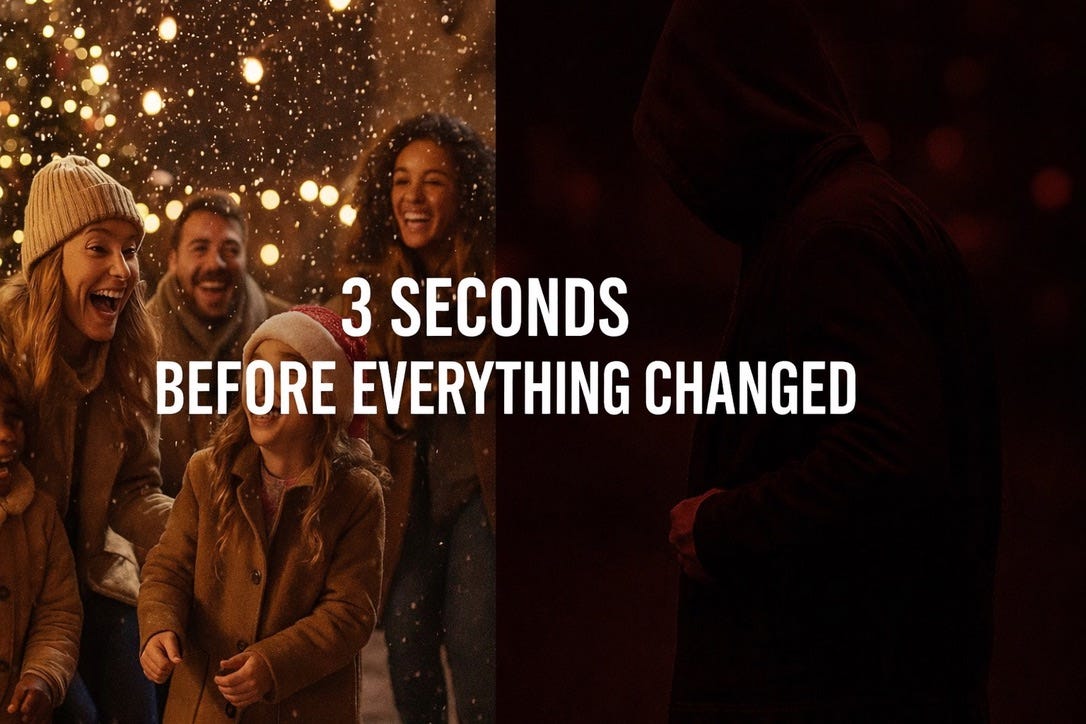
THIS STORY IS FICTION. THE PRINCIPLES ARE NOT…
LIVEFIRE TRAINING ACADEMY COTTAGEVILLE, SOUTH CAROLINA
Late afternoon sun hung low over the Edisto swamp, casting shadows across standing water between cypress trees. It was an unseasonably warm day for late December in the low country. The humidity clung to skin like a damp cloth, making every breath feel slightly heavier. The air smelled of pine sap, swamp mud, and gunpowder from the range.
Daniel Keene positioned himself on the grass firing line, his gray Born Primitive T-shirt already darkened with sweat patches under his arms and across his broad chest. His shoulders remained loose, his stance balanced and unassuming, and there was no tension in his body at all.
Downrange, three faded cardboard USPSA targets stood sentinel at precisely ten yards, spaced a yard apart, their scoring zones marked with brown paster outlines from previous runs.
His Taran Tactical Glock 17 Combat Master with a Trijicon SRO red dot nestled securely in his holster, and the custom stippling on the grip bit into his palm like an old friend’s handshake. He’d been loyal to Taran’s craftsmanship since 2012, back when Taran Butler began a niche company with high quality products for dedicated competitive shooters. That was long before their firearms graced the silver screen in high octane blockbusters.
The pro timer clipped to his belt displayed a 1.9 second par time in glowing digits. Daniel thumbed the delayed beep button, allowing the tension to build in the silence. His eyes locked forward to a small spot on the first target and he was relaxed and controlled as he’d trained for years.
BEEP.
His draw was fast and fluid. Two rounds center mass, recoil absorbed seamlessly. Transition right, and eyes going to the next spot. Two more shots, precise and unforgiving. Transition one last time to two final reports that echoed across the swamp.
The timer chirped: 1.84 seconds. He quickly inspected the targets. All hits clustered in the A zone, tight groups that spoke of relentless repetition rather than luck.
He reset the timer.
Run it again. 1.79 seconds. Clean run, no flyers.
No triumphant smile creased his face. Just a light nod of satisfaction, a steady exhalation.
The modified Blake drill had been ingrained in his regimen for decades. It dated back to his early career with the Agency, in denied areas where a split second of hesitation could mean a shallow grave in foreign soil. Later, as a Federal Agent protecting diplomats overseas, it kept him sharp and on point. Memories surfaced without warning.
Gravel crunching under boots on a moonlit road outside Kandahar. Burning tires and oily smoke on a rooftop in Mosul. The dull concussion of a breaching charge hitting a reinforced door in some nameless alley. Gunfire in tight spaces. The metallic smell of blood afterward.
Those memories didn’t haunt him. They hardened him. They were reminders that civilization was fragile, and that chaos never strayed far away.
He holstered the Glock with a soft, final click, stepping back from the 10-yard line. That’s when the chaotic scrabble of paws on the grass range reached his ears, growing louder like an approaching storm.
“Maverick,” Daniel murmured without turning, his voice a low rumble.
The Vizsla burst from behind the range’s shoot house. A streak of copper fur propelled by boundless energy, ears flapping wildly. He skidded to a halt just inches from Daniel’s boots, tail wagging furiously, pink tongue lolling as he shoved his wet nose insistently against Daniel’s thigh, demanding attention. “You’re a maniac buddy,” Daniel said, a hint of amusement softening his tone as he dropped a hand to scratch behind the dog’s ears.
Maverick emitted a deep, contented groan, leaning into the touch before abruptly spinning and darting toward the swamp’s edge, vanishing into the underbrush in pursuit of some invisible quarry.
Maverick technically belonged to the range owner, but he’d adopted Daniel as his own, perhaps recognizing the quiet intensity in the man who moved with the purposeful grace of someone who’d danced with death.
Daniel slung his range bag over his shoulder and walked to his pickup, trail running shoes kicking up small puffs of dust. At the driver’s door, he paused and looked back across the quiet range.
Frogs had started up, their chorus rolling through the cooling air. Cicadas buzzed in the distance. The sun dropped lower, turning the sky red and amber as the swamp swallowed the light.
This part of his life still made sense. Skill. Discipline. Awareness sharpened by habit. He climbed into the truck, started the engine, and drove off as the sun slipped below the horizon.

LATER THAT EVENING
SUMMERVILLE, SOUTH CAROLINA
Emily appeared at the front door before Daniel shifted into park, backlit and smiling. “You smell like the swamp,” she smiled as he climbed the steps.
“Better than how I used to smell coming home.”
She kissed his forehead. From inside came the thunder of small feet. Lily burst through the doorway and wrapped around his legs.
“Daddy! Did you practice today?”
He knelt to her level. “I did, kiddo.”
“Did you win?”
“Always.” A white lie. Drills weren’t about winning. But she beamed like he’d conquered the world.
Over dinner, Lily recounted her sea turtle project while Emily shared clinic stories. Daniel listened, cataloging sounds without meaning to: forks scraping, the refrigerator’s hum, the neighbor’s dog.
Later, after Lily was in bed, he cleaned his Glock at the kitchen table—slide, barrel, bore snake, oil on the rails. The ritual was meditative, a bridge between who he’d been and who he was trying to be.
On the back patio, he lit a fire and cracked a Pluff Mud Porter. Emily joined him, tucking under his arm.
“Tomorrow will be fun,” she said, watching the flames.
“It will.”
They sat in comfortable silence. For that moment, the world felt balanced.
MEDICAL UNIVERSITY OF SOUTH CAROLINA (MUSC) CHARLESTON, SOUTH CAROLINA
Leah slammed her locker shut, the clang echoing through the nurses’ lounge. Her scrubs clung uncomfortably, stiff with dried sweat and the faint metallic undertone of blood that no amount of washing fully erased.
Her feet throbbed from twelve relentless hours in the trauma unit. It was a whirlwind of chaos: a multivehicle collision on I-26 that brought in mangled limbs and fractured skulls, a gunshot wound from a domestic dispute that required frantic stabilization, an overdose patient who flatlined twice before her team’s compressions and epinephrine pulled them back from the brink.
The incessant beeps of monitors still rang in her ears, the burn in her arms from CPR a lingering phantom.
She shrugged into her jacket, the cool fabric a brief respite against her flushed skin, and pushed through the hospital doors into the crisp evening air.
Charleston buzzed with pre-holiday vitality: the clip clop of horse-drawn carriages on cobblestone streets, laughter spilling from dimly lit bars on King Street, the salty harbor breeze carrying hints of fried seafood from nearby eateries.
Leah paused at her favorite corner café, the bell above the door tinkling cheerfully as she entered. She ordered an almond croissant, its flaky layers warm and buttery, and settled by the window with a steaming black decaf coffee.
Outside, life paraded by: couples strolling hand in hand under gas lamps, students hunched over laptops in coffee shops, tourists capturing the historic charm with their phones. Leah observed them with a mix of envy and exhaustion, yearning for their unburdened ease.
Her profession was a calling, but it exacted a toll.
She needed an escape, a sliver of joy. Tomorrow’s early New Year’s Eve celebration at Charleston Place promised just that. No codes blaring, no trauma bays filled with agony. Just a little laughter and something profoundly human.
Finishing her pastry, crumbs scattering like confetti, she walked the short distance to her compact apartment on Broad Street. The key turned with a familiar click, the door creaking open to reveal a dimly lit sanctuary of bookshelves and potted plants.
Shoes kicked off by the entrance, she collapsed face first onto her bed, the comforter muffling her sigh of relief. Sleep descended swiftly, dreamless and restorative.
If you rely on our briefings to stay ahead of what’s coming, upgrade today. Your support keeps Dead Drop Intel independent and our intelligence flowing - no filters, no sponsors, no censorship.
UNDISCLOSED SAFEHOUSE, NORTH CHARLESTON — DECEMBER 30, EVENING
The abandoned warehouse near the old Navy base loomed in the dark, corrugated metal walls rusted and tagged with fading graffiti.
Inside, the vast space was dimly lit by hanging work lights that swayed slightly in the draft from cracked windows, casting flickering shadows across concrete floors stained with oil and debris.
The air was stale, heavy with the scent of damp mildew, machine grease, and the faint chemical odor of improvised materials being assembled in the gloom.
Six men operated in near silence, their movements efficient and rehearsed, drawn from disparate corners of a fractured global network. Former fighters from Syria’s civil war, recruits from Pakistani border regions, all unified by a radical vision honed in remote training camps.
Mirwais Akbari, the cell leader, a light skinned Tajik with reddish hair and blue eyes that allowed him to pass unnoticed in Western crowds, hunched over a workbench meticulously going over his handiwork. He smiled from ear to ear. He was about to live the day he dreamed about for years.
Ahmad Hotaki, his blonde-haired counterpart with similar features chosen for camouflage, inspected a set of compact submachine guns. They were CZ Scorpion EVO 3 A1s acquired through underground arms dealers in Eastern Europe.
The weapons had been shipped in disguised cargo and cleared through a port contact who was paid a substantial bribe at the Wando Welch Port Terminal in Mount Pleasant, just across the Cooper River from Charleston.
Chambered in 9mm, and mounted on top were Aimpoint T2 red dots. These Czech machines were designed for close quarters devastation.
Magazines taped in pairs for quick reloads, each man assigned six in tactical pouches hidden under loose clothing.
Ahmad tucked the weapons into nondescript duffel bags, alongside body cameras for online streaming.
Their reconnaissance of the target had wrapped weeks earlier: hotel blueprints studied, event schedules timed, vulnerabilities noted.
The strategy was straightforward yet vicious: initial detonation to scatter and panic, followed by armed entry, corralling into confined spaces for prolonged horror, broadcast live to force a response that maximized casualties.
As dusk fell, Mirwais surveyed the gear one last time. Everything was ready. Tomorrow they would move.”
JAMAL’S NORTH CHARLESTON APARTMENT - DECEMBER 30, EVENING
Jamal sat on the edge of his mattress, phone glowing in the dark. The message had come an hour ago: Tomorrow. Commit fully. Eternal reward awaits.
He’d typed three responses and deleted them all.
His Charleston Place uniform hung on the closet door, pressed and waiting. In six years of security work, he’d helped lost tourists find their rooms, called cabs for drunk wedding guests, escorted cleaning crews through back corridors. The most dangerous thing he’d ever faced was a belligerent groom who’d locked himself out.
The apartment felt smaller every time he looked at his phone. Peeling wallpaper. A fridge that hummed and clicked irregularly. Sirens from the interstate. He’d come to Charleston for something better than this, but “better” kept receding like a mirage.
It started online. A forum. Then private messages. They’d seemed reasonable at first. Initially, it was discussions about injustice, about forgotten communities and about faith. Then the tone shifted. Suggestions became expectations. Expectations became demands.
Then came the photos.
His sister Amira, walking to school in Aleppo. His mother at the market. Grainy surveillance shots that said: We know where they are. We can reach them.
Three weeks ago, he’d tried to stop it.
The FBI field office was in Mt. Pleasant, just across the Ravenel bridge from Charleston. Jamal had driven past it twice before parking two blocks away. His hands shook on the steering wheel.
Inside, fluorescent lights hummed. A receptionist looked up from her desk, professional smile in place. “Can I help you?”
The words had been rehearsed. I’m being threatened. They want me to help with an attack. I don’t know when or where, just that it’s coming. They have my family.
But standing there, under those lights, the calculation changed.
What could he actually tell them? Screen names that disappeared. Encrypted messages on apps that auto-deleted. Messages routed through VPNs across three continents. He had no names, no faces, no locations. The FBI would ask questions he couldn’t answer.
And while they asked, while they investigated, while they tried to trace digital ghosts—his mother would go to the market. Amira would walk to school.
The receptionist’s smile faltered slightly. “Sir?”
“I—” His throat closed. “Visa question. Wrong office. Sorry.”
He’d left before she could respond.
That night, the message came at 2 AM:
Interesting visit today, Jamal. You were inside for 4 minutes and 22 seconds. We were impressed by your restraint.
Your mother’s address is 1247 Al-Rashid Street, second floor apartment. Amira walks to Al-Nour school—takes the shortcut through the market, arrives at 7:45 AM. Shall we verify these details in person?
Attached was a photo. Not surveillance footage. A photo taken from across the street, through the FBI office window. Him, standing at the reception desk.
They’d been watching the FBI. Not just tracking his phone. Not monitoring from overseas. They had people here, in Charleston, watching the building in real-time.
After that, Jamal stopped trying.
Jamal had stopped responding to the messages weeks ago. They kept coming anyway.
Your family’s safety depends on your faith.
True believers don’t hesitate.
Tomorrow you prove your commitment.
He knelt on the prayer rug, forehead to the floor, but the words wouldn’t come. Just fractured thoughts. Allah, forgive me. I don’t want this. I don’t believe this. I’m scared.
The phone buzzed again. He didn’t look.
Outside, someone’s car alarm went off, then stopped. The fridge hummed. The hours of the long night crawled forward, merciless and slow.
MORNING OF DECEMBER 31, 2025
Charleston woke to clear skies and holiday energy. Tourists flooded the historic district early. At Charleston Place, staff prepped for the afternoon’s Let It Snow event.
Daniel brewed coffee while Lily danced in her holiday dress. He pulled up Charleston Place’s layout on his computer. He briefly looked at floor plans, exits, intersecting streets and landmarks. He did this anywhere he took his family. Old habits die hard.
Leah woke sore from her shift but energized by the promise of escape—no trauma bays, no codes, just celebration.
Elsewhere, the day moved with purpose. Mirwais checked batteries, tested cameras, reviewed the plan one last time.
When dawn came, Jamal was still sitting on the edge of the bed.
His phone lit up. A video. Ten seconds. His mother leaving for morning prayers, headscarf adjusted against the wind.
The camera followed her the entire way down the street.
They were still watching.
Jamal stood. Walked to the closet. His hand touched the uniform’s fabric—stiff, clean, pressed.
He could run. He could drive to the airport. He could disappear.
They would do whatever they planned to Amira. They would do it to his mother.
He could save himself. He could damn them.
His hand closed around the hanger. The metal felt cold against his palm. It was the same cheap wire hanger he had used for years. Now it seemed heavier than anything he had ever carried.
For a fleeting second, he smelled his mother’s cooking. Warm flatbread and lentil stew drifted from the kitchen in Aleppo. The memory hit so sharply that it stole his breath and made his eyes burn.
He pulled the uniform down and began to dress.
The decision had been made for him weeks ago.
He had just spent all night pretending there was still a choice.

LATER THAT DAY
Daniel wiped his face with his shirt after the afternoon sweat session in the gym. A text from Emily: We’re leaving around five. Copy, he typed back
The workout faded from his mind as soon as it was over. Just another day.
Leah spent the afternoon walking the city, Charleston alive in a way it only ever was on holidays. Market Street buzzed. She sat with a coffee near Marion Square, watching the world pass by. Laughter.
Tourists posing for photos. Couples leaning into each other against the cool air. Everything felt light.
Emily handed Daniel the keys. “Ready?” she asked. He looked at his family, at how normal everything felt, and smiled.
He grabbed his Taran Glock 17, did a quick press check to make sure a round was in the chamber, then holstered it into the appendix carry Tier 1 concealed holster. He also clipped his favorite Emerson Raven folder that he’s been carrying since 2000. “Yeah. Ready,” he said. “Let’s go.”
In the warehouse, the terrorist cell geared up: submachine guns, mags, cameras. Catering disguises donned, badges forged. Plan was memorized by everyone in the cell.
Jamal clocked in for his shift, eyes vacant, heart pounding. Smiled when spoken to. Nodded when required. No one looked at him twice.
ARRIVAL — CHARLESTON PLACE
The Market Street Circle courtyard hummed with celebration. Children darted between palm trees dusted with artificial snow drifting from machines overhead. Charleston Place’s Let It Snow event had transformed the space: massive Christmas tree, holiday lights wrapped around columns, Nutcracker décor standing guard at the edges.
The air smelled of mulled cider, popcorn, and cocoa. A live band tuned instruments on the elevated stage, test chords blending with laughter and chatter. Snowflakes caught the lights and sparkled against historic brick.
Daniel parked on Hassell Street in a small self-pay lot right behind the restaurant Fig. This was his go to parking spot when he transited downtown.
They walked down toward Market Street with the flow of families heading the same direction. He wasn’t on full alert. He wasn’t “working.” He was a husband and a dad heading into a holiday courtyard.
Still, his mind did what it always did without asking permission—registering where the crowd naturally compressed, where it thinned, where exits pinched down, where service corridors disappeared into shadow.
Lily skipped ahead, her small hand clasped in Emily’s, eyes wide with wonder at the chocolate fountain bubbling near the center. “Daddy, look! It’s like a fairy tale!” Emily chuckled and squeezed Daniel’s arm. “Relax, Dan. It’s a party. Let go a little.”
He managed a smile. He even meant part of it.
Lily reached up to catch snowflakes on her tongue. For a moment, he felt normal
Leah arrived on foot, weaving through the growing throng, the energy lifting her spirits. She grabbed a cocktail from a bar cart and found a spot near the edge, close to the entrance for easy access.
The vibe was infectious: a young couple dancing to the band’s warmup, tourists snapping selfies with the fountain.
Unseen, the caterer company vans pulled into a rear service alley, the team disembarking in catering uniforms, duffels slung like supply bags. They blended seamlessly with the staff hustle, badges flashing just enough to deter glances.
The band launched into an upbeat cover of “Winter Wonderland.” The crowd cheered, clapping along. The clock ticked inexorably forward.
Daniel’s intent gaze caught on a security guard near the entrance. Jamal, according to the name tag. Mid-twenties. Olive skin. Sweating despite the mild evening. Hands fidgeting under a bulky jacket that hung oddly, suggesting concealed bulk.
His eyes darted erratically, nothing like the steady sweep of trained security or the bored patience of an employee watching families drink cocoa. It struck a memory hard.
Not certainty. Not a diagnosis. Just a file folder in one of the several boxes in Daniel’s mind opening on its own. He didn’t act on it. He didn’t start barking orders. He did what he’d learned to do in crowded places overseas.
File it. Monitor. Don’t create a scene without cause.
THE SPARK
Daniel stood near the courtyard’s periphery with Lily balanced on his shoulders, her giggles vibrating through him as she clapped to the band’s rhythm. Emily snapped a photo with her phone; her face lit with genuine delight. Daniel’s eyes drifted back again, the way your tongue checks a sore tooth without thinking.
Jamal had moved. Not toward a wall. Not toward an exit. Deeper—toward the densest cluster near the fountain and cocoa station. Families, kids, strollers, people pressed together. His face looked wrong now, washed out and tight. Lips moving like silent recitation.
Hands disappearing beneath the jacket and reappearing. Daniel felt his body tighten. His brain tried the normal explanations first. Panic attack. Drugs. Medical issue.
Then Jamal’s hand came out. Not empty. A small device clenched in his fist. Daniel saw it clearly, and in that instant the calculation finished itself. This was no longer a feeling. It was a fact.
Daniel slid Lily down from his shoulders quickly but gently, like he was ending a piggyback ride. He kept his voice low, controlled. “Bug, go with Mommy”. Emily’s smile faded when she heard him. “Dan?” He didn’t say “bomb.” He didn’t say “terrorist.” He didn’t want to stampede his own family. He leaned in close, urgent, and spoke like a husband, not an operator. “Take Lily back to the parking lot. Now. Don’t run. Just move like we’re leaving early”.
Emily’s eyes flicked past him to Jamal, to his hand. She understood. No argument. No disbelief. She grabbed Lily’s hand and turned them both smoothly back the way they came, blending into the natural outward flow of families who were already drifting toward Market Street and the sidewalks.
Lily protested once. “But Daddy—” “Go with Mommy,” Daniel said, steady. “I’ll be right behind you”. Emily didn’t look back. She walked fast without running, Lily half trotting to keep up, boots slipping slightly on the brick dusted with fake snow.
Daniel watched. Emily moved fast. Safe. Moving away.
Then they disappeared into the crowd.
What if you’re wrong?
Maybe it wasn’t a device. Maybe he’d just sent his family away from a holiday party because his brain couldn’t turn off. Maybe in five minutes Emily would give him that look.

THE INITIATION
Within three seconds, Jamal stopped near the front of the hotel, close enough to the lobby doors that the blast would drive inward, feeding both the building and the courtyard.
Three seconds.
That was all it took for everything to change.
His eyes squeezed shut.
“Allahu Akbar,” he muttered, almost lost under the music.
Daniel lunged forward and shouted once.
“DOWN!”
The detonation was cataclysmic. Daniel dove behind a heavy stone planter as the blast struck, the force slamming through his body. Stone fractured. Air vanished. His ears rang with a piercing whine as the world tore itself apart.
A brilliant flash glowed between the buildings. A heat wave slammed outward carrying the stench of explosive burn and seared material. Shrapnel—glass, bolts, ball bearings—whined through the air and struck flesh, stone, and holiday décor with sickening thuds.
The chocolate fountain burst into a spray of brown and red. Decorations turned into cutting debris. The stage lights jittered and died. The band vanished into smoke and screaming. People were thrown to the ground.
Others stumbled and collapsed. The artificial snow fell into smoke and blood like a cruel joke.
Daniel did a quick self-assessment: small penetrating shrapnel wound on his upper left arm. Other than it bleeding, he could still move it. His Glock was still secure and his phone intact.
A young mother, mid laugh, thrown backward with her toddler still in arms, her back shredded by fragments. An elderly couple near the stage collapsing in a tangle, the man’s glasses shattered, blood blooming from multiple punctures.
A teenage boy stumbled past, phone still raised, his arm nearly severed at the elbow. Arterial spray arced in rhythm with his steps.
A father lay on top of his bleeding daughter, her legs limp, screaming for help as several people trampled on him as they ran by.
A woman crawled on all fours, glass embedded in her palms, leaving bloody trails on the pavers.
A child’s shoe lay abandoned on the brick, laces still tied. Panic ignited like wildfire. Survivors surged away from the open courtyard, desperate for walls, cover, anywhere that wasn’t exposed.
And then the gunfire started.
THE SECOND WAVE — GUNFIRE AND THE FUNNEL
From the service access and edges of the courtyard, Mirwais’s team emerged—shedding duffels and the last thin layer of disguise. More bodies jerked and fell: a man shielding his wife hit in the back, collapsing atop her; a group of tourists cut down mid run, limbs splaying.
The plan activated. Chaos outside to draw responders. A kill zone inside for the broadcast horror. The courtyard transformed into a battlefield, festive lights casting eerie glows over the bloodshed.
Submachine guns came up. Controlled bursts cracked through the haze, bullets punching into the fleeing crowd. “INSIDE!” Mirwais shouted in accented English. “MOVE INSIDE OR DIE!”
People didn’t need to be herded like cattle. Terror did the work. Survivors ran toward the lobby doors, pressed together, desperate to get away from the courtyard and the smoke. The front lobby became a choke point in seconds. The chandelier overhead trembled.
Marble floors slicked with blood reflected red and gold light from the holiday décor. Velvet chairs were overturned. Phones and purses scattered like debris.
And dominating everything: the grand double staircase. Up felt like safety. Up felt like distance from the blast. Up felt like escape. The attackers didn’t have to clear the stairs. They used presence, shouting, and gunfire to keep the mass moving.
People stumbled upward in waves. At the top of the staircase, the crowd flowed left down the hallway. Then came the intersection. Armed men redirected them with simple commands and raised weapons, shooting into the ceiling for attention.
Down the corridor leading to the Grand Ballroom. The doors swallowed them, first dozens, then hundreds, until the space itself became containment.
OUTSIDE: TRIAGE
The blast wave hurled Leah to the ground near the Market Street entrance, the pavers slamming into her back, air forced from her lungs in a whoosh. Ears popping, vision spotting, she tasted blood from a bitten tongue.
Shrapnel whizzed past, embedding in nearby cars and walls with metallic pings. Screams pierced the ringing in her head—raw, animalistic.
Training overrode shock. She rolled to her knees, scanning the perimeter: the street a scene from hell, wounded staggering out from the courtyard gates, others collapsed on sidewalks.
Her medical bag was in her car, parked two blocks away on a side street—no time. She always carried basics in her purse: nitrile gloves, a tourniquet, hemostatic gauze, chest seals from her ER kit.
First victim: a woman in her 30s, staggering while clutching a mangled arm, brachial artery spurting in rhythmic pulses. Leah intercepted her, guiding her behind a parked SUV for cover. “Sit! I’m a nurse, hold still”.
Gloves snapped on, tourniquet looped high on the arm, cranked tight with the windlass rod until the bleed slowed to an ooze. The woman whimpered, shock paling her face. “Breathe slow. Help’s coming”.
Next was a man on the curb in his mid-forties. Shrapnel had peppered his chest. He gasped with wet, sucking breaths. Pneumothorax. Leah probed gently and confirmed the wound. She applied a chest seal from her kit, occluding three sides to allow air to escape. “Lie on your injured side. Good. Stay with me.”
Bystanders froze or fled, but Leah barked orders: “You—in the blue shirt! Press here on this leg wound—hard!” A college kid complied, hands shaking as he compressed a femoral bleed on a teenage girl whose jeans were soaked crimson. “Don’t stop until medics arrive!” Sirens wailed closer, first responders were en route.
She packed wounds with gauze, elevated limbs, coached breathing.
Gunfire cracked from inside the hotel, echoing between the buildings. Active shooter.
Leah flagged arriving cops: “Blast injuries, fragments, GSWs! Set up triage point closer to King Street and out of the line of fire”.
She knew the paramedics wouldn’t come in while rounds were still cracking. Not until police stopped the gunfire and declared the area safe. The corner of King Street and Market Street became her impromptu ER, lives hanging by threads she knotted tight.
ENTRY
Daniel couldn’t abandon the screams echoing from deeper inside, the pop pop of submachine fire punctuating the alarms like death’s metronome. This was his domain—close quarters combat, intel gathering in hostile environments.
He was still bleeding from a shrapnel wound on his upper left arm. However, now wasn’t the time to worry about it. He needed to get off the X and find another way into the hotel. He would have time to deal with it later.
But he wasn’t going cowboy; priority was getting eyes on, relaying to responders, not playing hero. Lives depended on information, not bravado.
He ran down King Street looking for an alternate way to slip into the hotel without being noticed. He immediately located an emergency exit door located about half way between the Louis Vuitton and Gucci Stores.
He remembered seeing it before when he took his wife shopping for purses at the Gucci store. He immediately took out his multitool and jimmied the door open. Once he popped the door open, he cleared through the threshold with his Glock in a high ready, scanning for threats.
He took a brief tactical pause to listen and get a sense of what was happening inside. He always remembered the phrase, “Don’t be in a hurry to run to your own death.” He found an old rag and stuffed it into his shirt sleeve to slow the bleeding from his wound.
He could still hear sporadic gunfire and people running and screaming on the 2nd floor. He knew from the layout of the hotel that it seemed like the flow was running toward the grand ballroom on the 2nd floor. He needed to somehow get eyes on the situation and report back to the first responders.
He immediately got on an encrypted app and started typing on an ongoing chat he had with various Federal Agents and some Officers of the Charleston Police Department SWAT team. He still communicated regularly with several law enforcement Officers even after he retired. He sent a quick sitrep on the app.
He cleared up to the 2nd floor door in the stairwell. All of the shooting, running and screaming ceased. There was a small window in the door and he stayed far enough away where he could see the hallway on the other side.
Once he thought it was safe, he aggressively popped the door open, then cleared the space and tactically made his way down the right hallway into a back corridor of the hotel. Clear left. Clear right. Breathe. Move.
He found an electrical/maintenance room and ducked into the room with the door clicking shut behind him. Shelves of janitorial supplies, tools. A wall chart: hotel blueprints—ballrooms, service corridors, HVAC schematics. Jackpot. The ducts ran like veins above the main areas, access panels in ceilings.
He had an idea that just popped into his brain. He eyed the duct access. Tight spaces. Poor visibility. Easy to get trapped. But he’d done worse in Mosul. It wasn’t the best option, but he needed valuable information and couldn’t live with himself if he didn’t try.
Before he did anything, he texted back to the encrypted chat and passed the latest information. By this time, several Police Departments from within Charleston County and nearby surrounding counties were en route due to the magnitude of this event. Also, the local FBI office was en route and already activated the Hostage Rescue Team (HRT) in Quantico, VA.
He pried open the grill with his multitool. The metal groaned softly. Then he hoisted himself up into the aluminum tunnel.
Halfway through pulling himself in, he froze.
What the hell are you doing?
He wasn’t twenty-five anymore. He wasn’t on active duty overseas. He had a daughter waiting at home who needed a father, not a hero’s funeral.
The duct felt smaller than it looked. It was claustrophobic and disorienting. If they heard him up here, he would be trapped. There would be no room to maneuver and no way to fight back.
Emily’s voice echoed in his head: Relax, Dan. It’s a party. Let go a little.
He had promised her he was done with this life.
For a second he pictured Lily’s face pressed to the truck window in the parking garage, waiting for Daddy to walk out of the smoke. The image hit harder than any shrapnel, forming a cold knot in his gut that almost pulled him back down.”
“Then he heard it through the ductwork: a child crying.”
He pulled himself the rest of the way in and started crawling. Dust choked the air. His elbows scraped as he crawled forward. The flexing metal popped under his weight. Sweat beaded, but his breathing remained controlled.
He crawled stealthily to about twenty feet away from the grate overlooking the Grand Ballroom. He couldn’t see into the ballroom from his position, but he could faintly hear the terrorists talking.
The terrorist leader, directed in Pashto: “Streams live now. One kills every 20 minutes. Start with the women or children for more impact. Rig the doors with charges; force their assault into our trap”.
Daniel’s Pashto, rusty from deployments, caught the essentials: execution schedule, no negotiations, bait for SWAT breach to amplify kills. He had no idea of how many hostages were in the ballroom, but he guessed it was probably somewhere between 150-200 hostages.
He could also hear several voices and guessed there was probably at least 4 or 5 tangos present.
He left torn pieces of paper throughout the HVAC duct during the initial approach so he would know the path back to the mechanical room on the way back.
He very slowly crept back toward the direction he came from. He stopped several times because he noticed the terrorist team started sending roving patrols out to find stragglers and lock the whole 2nd floor down. He would see them through the grate, then keep slowly moving back to the mechanical room.
The last piece of duct slid back into place with a muted scrape. Daniel froze. Somewhere down the hall, boots stopped. A voice murmured in Pashto. He killed his light and stepped away from the wall just as the handle to the mechanical room turned. The door opened slowly. A silhouette filled the doorway, flashlight sweeping low. Rifle slung. One hand on the radio. “Probably nothing,” the man muttered in Pashto. The door clicked shut behind him.
That was the moment.
Daniel crouched in the recessed alcove behind a utility shelf. His shoulder pressed to the wall, breathing slow and shallow through his nose. The shrapnel graze on his upper left arm burned, but the bleeding had slowed considerably. He listened. Footsteps. One set. Measured, not hurried.
A low voice speaking Pashto into a radio—irritated, not alarmed. He never saw the alcove. Daniel didn’t rush. This wasn’t rage. This wasn’t vengeance. It was necessity. The distance was twelve feet. He closed it in a heartbeat.
His right hand dipped to the pocket of his jeans, thumb flicking the Emerson Raven open with a practiced wave. The signature arc of steel snapping into place in under a second, the drop point locking with a metallic click. The terrorist’s head turned at the faint sound. Too late.
Daniel exploded from the shadows. Lead hand clamped the man’s mouth and jaw like a steel trap, yanking the head back and to the side, exposing the neck. The Raven drove in at forty-five degrees just below the ear, blade punching through soft tissue and cartilage with surgical violence.
Daniel ripped it forward in a vicious Filipino Kali slash—severing carotid, jugular, and windpipe in one fluid arc. Blood erupted in a pressurized gush, hot and coppery, painting the wall in a wide arterial fan. The CZ Scorpion clattered to the tile as the terrorist’s hands flew instinctively to his throat.
Daniel stayed on him, body weight driving the man backward until his shoulders slammed the wall. The Raven struck again in a blur of motion, then delivered two more blows with deep, penetrating cuts that found the subclavian pocket and upper chest. The blade rotated as it withdrew to tear the wounds open further.
Each strike was mechanical with the same economy of motion he’d done countless times before. The gunman’s eyes went wide from shock, not pain yet.
A wet, gurgling attempt at a scream bubbled through severed vocal cords. Daniel rode him down, by pressing on the back of his knee with his own while maintaining control. His knife was poised for the finishing stroke if needed.
It wasn’t.
Blood sheeted across the terrorist’s chest plate, soaking the hoodie, pooling fast on the marble floor. His fingers clawed uselessly at the gaping ruin of his neck, trying to stem the torrent. Dark crimson pulsed between them in rhythmic spurts, slowing with each fading heartbeat.
Daniel watched him die. No emotion. No hesitation. Just confirmation. The man’s eyes glazed, hands fell limp, body sagged sideways into the spreading lake of his own blood.
Daniel knelt, wiped the Raven’s blade in two deliberate passes across the dead man’s hoodie—once on the shoulder, once on the chest—then folded the knife with a flick of his wrist and slipped it back into his pocket. The entire encounter had taken less than six seconds.
He stood. One less threat. Behind him, the corridor was silent except for the soft drip of blood on carpet and the distant wail of sirens closing in.
INTEL
After his heart rate calmed back down, Daniel immediately pushed the intel gathered from the ballroom and advised where he was located in the Hotel. The last thing he wanted was a blue-on-blue incident when SWAT breached.
He knew SWAT would most likely have to breach from multiple points simultaneously and with fast controlled aggression. However, the charges rigged up to the doors in the ballroom would be an issue.
Also, Daniel knew that the grand ballroom was on the backside of the hotel and basically encompassed the whole block between King Street and Hassell Street. There was an emergency fire exit that led from the 2nd floor ballroom area at the corner of the Grand Hall down to King Street.
He could hear the sounds of sirens in the distance… growing louder, closer, a cavalry racing against time.
But beneath it all, muffled through the walls of the Grand Ballroom, came the faint sounds that cut deeper than any gunfire: scattered sobs, a child’s high-pitched whimper, hushed pleas for help rising and falling like waves.
Hundreds of lives, trapped and waiting. Daniel exhaled slowly, grip tightening on the Glock. Those sounds weren’t stopping on their own.

THREE DAYS LATER
The final count was eighteen dead from the initial blast and gunfire. Forty-three wounded, twelve critical.
It could have been two hundred.
Charleston Police Chief Patricia Morrison stood at the press conference podium, exhausted. “The suspects are deceased. The investigation is ongoing. But I want to be clear about something.”
She glanced at her notes, then looked directly at the cameras.
“Two civilians present during this attack had the training and awareness to make a difference. One provided immediate medical intervention that saved lives in the critical window before paramedics could enter the scene. The other provided real-time intelligence that prevented a hostage massacre.”
She paused.
“They didn’t ask permission. They didn’t wait for someone else. They simply knew what to do and did it.”
DANIEL’S HOME – ONE WEEK LATER
Daniel sat on the back patio, beer untouched, watching the fire. Emily brought Lily out wrapped in a blanket, and they sat in silence.
“The FBI Special Agent in Charge said you saved a lot of people,” Emily said quietly.
Daniel didn’t respond immediately. He was thinking about the families in that ballroom. The child he’d heard whimpering through the walls. The razor-thin margin between preparation and catastrophe.
“I did what I was trained to do,” he finally said. “Anyone with the same training could have done it.”
Emily’s voice tightened. “I know what you were trained to do, Dan. I’ve known for years. But seeing it on the news… hearing what you actually did in there…”
She paused, swallowing. “I need you alive, not right. Do you understand that? I need you here, not in some ballroom playing hero while Lily and I wait to find out if you’re coming home in a box.”
The words landed like a gut punch. Daniel finally looked at her. In the firelight her eyes were wet, jaw set. She was the same woman who’d walked calmly away with their daughter while a bomb went off behind them.
He started to speak, but she wasn’t finished. “I’m proud of you. God help me, I am. But I’m also terrified. And angry. Because you didn’t hesitate. You crawled into a duct and killed a man with a knife and never once thought about coming home to us first.”
Silence stretched between them, broken only by the fire.
Daniel set the beer down. “I thought about you the whole time,” he said, voice low. “Every damn second. Lily’s laugh when she was catching snowflakes. You squeezing my arm telling me to relax.
That’s what kept me moving and knowing I had to make sure those bastards couldn’t do to anyone else what they wanted to do to the people in that room.”
He met her eyes. “I didn’t do it to be right. I did it because if I walked away and more kids died… I wouldn’t be able to come home to you anyway. Not really.
” Emily’s shoulders sagged. She crossed the distance slowly, sat beside him, and let him pull her close. After a long moment she rested her head on his shoulder. “
I hate that the world needs you to be this person,” she whispered. “But I’m glad you are.”
They sat like that until the fire burned down to embers, the weight of what almost happened settling over them like a shared blanket—neither warm nor comfortable, but theirs all the same.
If you rely on our briefings to stay ahead of what’s coming, upgrade today. Your support keeps Dead Drop Intel independent and our intelligence flowing - no filters, no sponsors, no censorship.
AUTHOR’S NOTE
This story is fiction, but the principles aren’t.
The terrorist tactics depicted—suicide bombers, coordinated small arms attacks, hostage scenarios designed to maximize casualties during response—are drawn from real-world events in Mumbai, Paris, Beslan, and elsewhere.
The difference in this scenario was the presence of two individuals with specific capabilities:
Daniel: Years of professional training in weapons handling, close-quarters combat, fighting skills, situational awareness, and tactical decision-making under stress.
Leah: Medical training with immediate trauma intervention skills—tourniquets, wound packing, airway management.
Neither was law enforcement or military (anymore). They were simply citizens who’d invested in skills that mattered when seconds counted.
A Critical Distinction:
Daniel’s actions in this story reflect decades of specialized training at the highest levels—covert operations, hostile environment work, federal protective services. His decision to infiltrate the hotel and engage threats directly represents capabilities far beyond typical civilian training.
The average armed citizen should not attempt what Daniel did.
Entering an active attack scenario, navigating hostile corridors, gathering intelligence in confined spaces, and engaging in hand-to-hand combat requires years of professional instruction, scenario-based training, and experience operating under life-threatening stress.
“Daniel’s story is fiction designed to be compelling. Your responsibility as a citizen is real, achievable, and doesn’t require you to be a tactical superhero. Most defensive scenarios won’t require infiltration or direct engagement. They’ll require you to move your family to safety, render aid, or provide accurate information to responders.”
The real lesson is this:
You don’t need to be an elite operator to make a difference. The skills that matter most in crisis are accessible to any serious citizen:
· Medical intervention: Tourniquet application, wound packing, and CPR can be learned in a weekend course and practiced regularly. Leah’s actions—stopping arterial bleeds, sealing chest wounds, organizing bystanders—saved more lives than gunfire and required no tactical background.
· Situational awareness: Daniel spotted the threat before it materialized because he’d trained himself to read behavior and scan environments. This costs nothing but attention and practice.
· Basic defensive skills: Quality firearms training, regular live fire practice, dry fire practice and understanding when and how to act within your capability level can make you an asset rather than a liability.
· Preparedness mindset: Knowing where exits are, check the layout, have a plan, know the difference between cover and concealment, carrying basic medical supplies and staying fit enough to move yourself and potentially others under stress. These aren’t operator-level skills. They’re citizen-level responsibility.
The statistics are clear: In active shooter events, the time between first shots and police arrival averages 3-5 minutes in urban areas. In that window, trained civilians have stopped or mitigated attacks in documented cases across the country.
This isn’t about vigilantism. It’s about realistic preparedness within your capability level.
Consider:
· Do you know how to apply a tourniquet? (This alone can save a life)
· Have you trained beyond basic firearms safety?
· Do you know the exits when you enter public spaces?
· Could you stop someone from bleeding?
· Do you carry even basic medical supplies?
What you should NOT do:
· Attempt to clear buildings or engage multiple armed threats without professional training
· Put yourself in situations that exceed your skill level
· Assume a concealed carry permit equals tactical capability
What you CAN do:
· Get serious medical training and carry a basic kit
· Develop genuine situational awareness
· Train regularly with your defensive tools
· Know your limitations and operate within them
· Be the person who stops a bleed, directs people to safety, or provides accurate information to responders
The gap between “that couldn’t happen here” and “it’s happening right now” is measured in heartbeats and seconds.
When that gap closes—and history suggests it will—the only thing that matters is whether you’re prepared to act within your capabilities to protect yourself and others.
Your responsibility as a citizen is real, achievable, and doesn’t require you to be a tactical superhero.
Preparedness isn’t paranoia.
It’s the quiet edge that saves lives when the world goes dark.
Start with what’s accessible. Train seriously. Know your limits. Be ready.
Stay ready and stay capable,
Ryan Geho
Copyright © 2025 Ryan Geho. All rights reserved.
Reading this had my heart racing and my breath stopped. That alone told me I have a long way to go to do the right things if i'm caught in a 'situation'. I've always looked for exits and hiding places whenever I go places, and watch how people are acting. That's certainly not enough. I'll be sharing this story.