


SUPPORT INDEPENDENT INTELLIGENCE
If you value reporting that says what others won’t, help keep it going. Guardians support the intel, research, and preparedness reporting we publish every day.
INTRO: WHAT THE MEDIA GETS WRONG
Our objective has always been to help people understand what the mainstream media either doesn’t understand, is purposely misrepresenting, or actively failing to inform the public about. In most cases, they don’t even understand what they are reporting. This is especially true when it comes to Iran’s military structure.
CommandEleven wrote an in-depth study into Iran’s Mosaic Defense doctrine. With a distributed, decentralized command structure, defeating or decapitating an army becomes significantly more difficult. This approach was shaped by lessons learned during the Iran-Iraq War and repeated Israeli strikes.
Iran cannot defeat a foreign army through conventional means—but it can wear down and defeat that same army using Mosaic Defense.
IRAN’S TRUE POWER STRUCTURE
When most people talk about Iran’s military, they point to the Islamic Revolutionary Guard Corps (IRGC), which holds more real power than both the Iranian government and the conventional army.
The IRGC generates billions through internal and external operations, funding black ops and expanding influence. Over time, it has developed a highly effective asymmetric warfare model—one that many nations still fail to fully understand.
Most analysts mention proxy groups like Hezbollah, Hamas, and the Houthis. But they often overlook key elements of Iran’s broader network:
Liwa Fatemiyoun (Afghanistan)
Liwa Zainabiyoun (Pakistan)
Popular Mobilization Units (Iraq)
Kata’ib Hezbollah (Iraq)
And most critically—they ignore the Basij Force.

THE BASIJ FORCE: ORIGINS AND PURPOSE
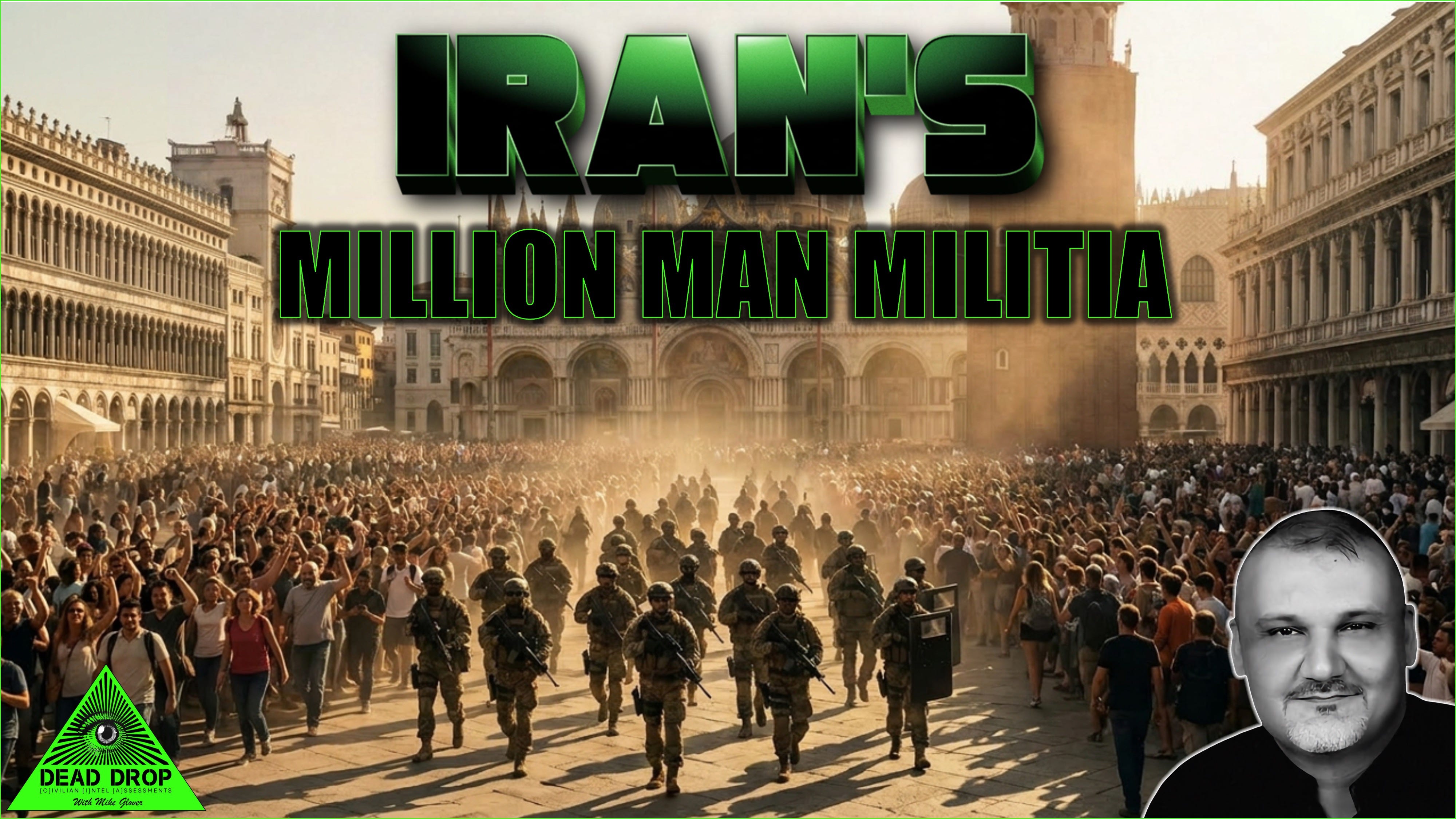
The Basij Force was established in November 1979 when Ayatollah Khomeini ordered the creation of a 20-million-person “people’s army.”
Its mission: defend Iran against both foreign invasion and internal dissent.
This is not just a militia. It is the regime’s paramilitary enforcement arm, designed to be mobilized at any time.
COMMAND STRUCTURE
The Basij command structure is simple but effective:
Supreme Leader
IRGC Commander-in-Chief
Basij Commander
Iran is divided into 32 IRGC provincial commands, each overseeing Basij battalions within its area of operations.
SIZE AND SCALE
The true size of the Basij remains intentionally opaque.
90,000 active members (CSIS estimate, 2005)
300,000 reservists
Up to 1 million rapid mobilization
Internal sources suggest the real number fluctuates between 1.5 and 3 million personnel, organized into approximately 2,500 battalions.
This force operates independently but in coordination with the IRGC and Iranian military.
TACTICAL STRUCTURE
The Basij is divided into four primary formations:
Imam Ali Battalions
Elite, heavily armed anti-riot and internal security units. First responders to urban unrest and infrastructure protection.
Imam Hussein Battalions
Combat veterans trained alongside IRGC Ground Forces. Focused on repelling invasions and conducting asymmetric warfare.
Ashura (Male) & al-Zahra (Female) Battalions
Neighborhood-level units responsible for local defense, surveillance, and ideological enforcement.
Beit-al-Moqadas Units
Rapid-deployment reserves used to reinforce frontline units during crises.
Additional branches embed within schools, universities, healthcare, and government sectors to monitor and influence society.
A NATIONWIDE SURVEILLANCE MILITIA
This is a force of millions—trained, ideologically driven, and embedded across every level of Iranian society.
They are present in:
Cities and villages
Schools and universities
Mosques and government offices
Factories and infrastructure sites
Mosques serve as command-and-control hubs for intelligence, recruitment, and surveillance.
🔥 TRIPLE VALUE. ZERO EXTRA COST.
Subscribe to Carnivault & get:
✔️ Premium protein
✔️ 12-month price lock in a volatile market
✔️ FREE SDN Guardians membership
With energy markets already spiking due to the expanding Iran conflict - and over 20% of global oil moving through the threatened Strait of Hormuz - locking in your meat price for the next 12 months isn’t a perk …
It’s protection.

MEMBERSHIP TIERS
Basij membership is structured into three levels:
Tier 1: Volunteers
Unpaid but receive state benefits, job preference, and social advantages.
Tier 2: Active Members
Uniformed personnel who complete a 45-day training program combining ideology and military basics.
Tier 3: IRGC-Selected Members
Elite tier integrated with IRGC leadership and military pathways.
ROLES AND OPERATIONS
The Basij performs multiple roles simultaneously:
Internal surveillance and informant networks
Riot control and suppression of dissent
Combat operations (Iran-Iraq War, Syria)
Counterinsurgency against ethnic groups
Disaster relief and civil services
Foreign deployments within the Axis of Resistance
They are both a security force and a social control mechanism.
TRAINING AND INDOCTRINATION
Basij members receive two primary forms of training:
Ideological-Political Training
Focuses on absolute loyalty to the regime. Requires ongoing re-certification.
Combat & Tactical Training
Ranges from basic instruction to advanced capabilities including:
Riot suppression
Urban warfare
Crowd control
CBRN defense
DECENTRALIZED STRUCTURE: BUILT LIKE A SLEEPER NETWORK
The Basij hierarchy is structured as follows:
Federal → Provincial → Cities → Districts → Neighborhood Bases → Cells
This mirrors how sleeper cell networks are organized globally.
Members are trained to blend into civilian life, making them difficult to identify.
STAY AHEAD OF THE THREAT
If this article helped you understand the danger, imagine having the intel before it hits the headlines. Guardians get private channels, real-time SHTF alerts, full SITREPs, and the preparedness guidance we can’t publish publicly.
WHY THIS MATTERS NOW
There are three reasons this matters:
In the event of a U.S. ground invasion, the Basij would be among the first forces encountered across Iran’s terrain.
Elements of the Basij are deployed internationally, including in Latin America and potentially within the United States for training and operational roles.
Iran has successfully built a multi-generational citizen militia embedded within society—raising the question of whether such a model could exist elsewhere.
THE BIGGER QUESTION
Iran has operated a decentralized, ideologically driven militia network inside its own borders since 1979.
That means decades of recruitment, indoctrination, and deployment capability worldwide.
The real question is not whether this model works.
The question is: how far has it already spread?
WHAT COMES NEXT
We will address that question—and whether a similar model could exist in the United States—in Part II.
Khalid Muhammad
Founder & Executive Director
CommandEleven
Dead Drop Intel is a reader-supported publication. To receive new posts and support the mission, consider becoming a free or paid subscriber.
THE NEXT LAYER IN RESILIENT COMMS
The POCLink PRO radio runs on Starlink, WiFi, and 4G - meaning you can still talk when cellular fails but internet stays up.
Your employer becomes the compliance officer in the third phase. We already live in a world where HR departments enforce ideological standards that go far beyond the workplace. Crisis conditions normalize accelerated enforcement. Noncompliant employees will be identified, flagged, and removed - all under the banner of keeping the organization safe.
