


BLUF (BOTTOM LINE UP FRONT)
The United States has lost effective control of its low-altitude domestic airspace. Small Unmanned Aerial Systems (sUAS)—ranging from hobbyist platforms to sophisticated state-sponsored fixed-wing assets—operate with near-total impunity over the Continental United States (CONUS), targeting military installations, power grids, and political leadership. Current Department of War, DHS, and Law Enforcement (LE) response is constrained not by technology, but by a catastrophic legal deadlock. Unless immediate legislative and regulatory “overhauls” are enacted to grant kinetic and electronic interference authority to local command and LE, adversaries will continue to map vulnerabilities in real-time, preparing the ground for high-consequence disruption or attack. The homeland is no longer a sanctuary; it is an unmonitored front line.
KEY TAKEAWAYS
Normalized Penetration: The presence of unidentified sUAS over critical CONUS infrastructure is no longer episodic; it is a normalized, daily operational reality. Adversaries have successfully transitioned from probing defense perimeters to establishing a persistent surveillance and signaling presence over strategic nuclear, power, and command hubs.
The Legislative ‘Kill Switch’: The primary barrier to neutralizing domestic drone threats is not a lack of kinetic technology but a paralysis induced by antiquated 20th-century legal frameworks (Title 10/18/49). These laws inadvertently protect hostile electronic systems operating over U.S. soil.
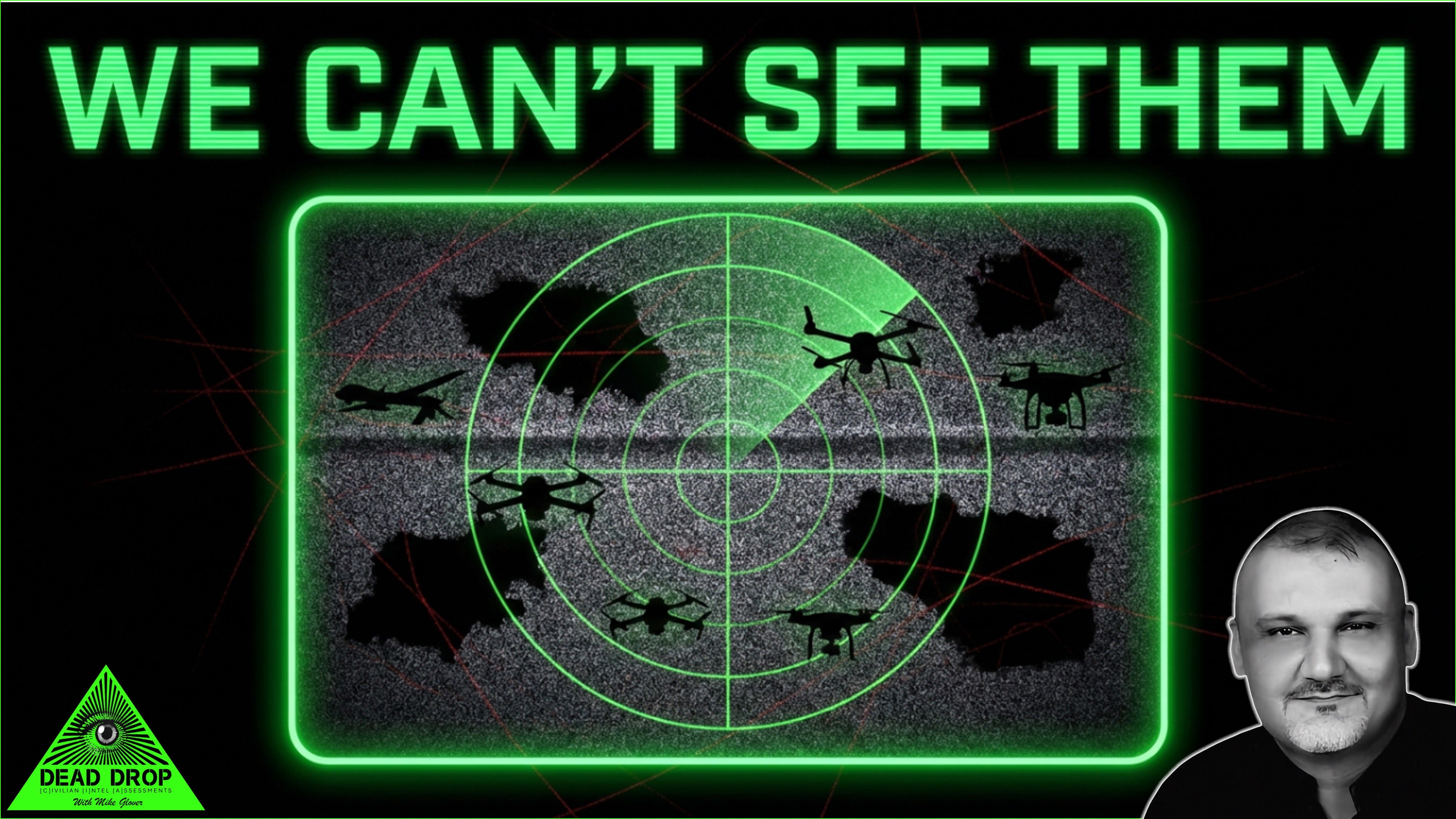
Domain Awareness Collapse: Current C-UAS (Counter-UAS) detection architectures are fragmented and reactive. The U.S. currently lacks a unified, integrated “air picture” below 2,000 feet for domestic airspace, leaving a decisive domain blind spot exploited by both state and non-state actors.
SITUATIONAL ASSESSMENT: THE LOW-ALTITUDE SIEGE
CommandEleven monitors a escalating cycle of sUAS incursions over key CONUS strategic assets. What began as anecdotal reports of “nuisance” drones has evolved into coordinated, sustained, and technologically advanced campaigns. The geography of these incidents confirms the strategic intent:
Strategic Nuclear & Command Facilities
The 2024 New Jersey incident, initially downplayed, involved dozens of large, fixed-wing drones operating simultaneously over dozens of distinct high-value targets, including military installations (Joint Base McGuire-Dix-Lakehurst), research centers (Picatinny Arsenal), and commercial hubs (Port Newark). Incursions over Barksdale AFB (Global Strike Command) and the Pantex Plant (nuclear assembly) have become frequent, showcasing the ability to probe the most sensitive security layers.
The National Capital Region (NCR)
The NCR is now regularly challenged. Recent incidents involve sUAS loitering at specific altitudes over residential areas of cabinet-level leadership (McNair) and key command centers (Andrews AFB). The signaling is unmistakable: if we cannot secure the skies over Washington D.C., we cannot project power globally.
The Tactical Shift
We have observed a distinct move from simple commercial quadcopters to larger, high-speed, long-endurance platforms that exhibit advanced electronic warfare (EW) resilience. These systems are optimized to bypass traditional perimeter radars—which were historically set to filter out small clutter like birds—and to operate autonomously, making standard radio frequency (RF) jamming largely ineffective.

DISCLOSURE: This post contains affiliate links. If you make a purchase through them, we may earn a small commission at no extra cost to you. This helps keep our work independent. Thank you for your support.
THREAT ACTORS AND CAPABILITIES: THE GREY ZONE
CommandEleven categorizes the domestic sUAS threat landscape by actor intent and technical footprint. The critical challenge is attribution ambiguity, allowing adversaries to exploit the “grey zone” between criminal activity and state espionage.
State-Sustained Espionage (The ‘Silent Hand’): China & Russia
Primary Intent: Signature Intelligence (SIGINT), Measurement and Signature Intelligence (MASINT), and real-time mapping of operational response.
Capabilities
HALE/MALE Mother ships: High-Altitude Long-Endurance (HALE) or Medium-Altitude (MALE) platforms operating just outside controlled airspace, acting as relational “relays” or “mother ships” for smaller sUAS swarms.
SIGINT collection: Advanced sensors tuned to “sniff” electronic emissions. Following the 2025/2026 incidents, it is confirmed that PRC assets are mapping the F-22’s specific radar and communication signatures at Langley, seeking to decipher stealth encryptions.
EW Resilience: These drones utilize encrypted control links or inertial navigation systems, rendering standard commercial C-UAS “jammers” useless. They are hardened against electronic interference.
STAY AHEAD OF WHAT’S COMING
If this matters to you, you should be seeing it in real time - not after it’s already happened.
Proxy Retaliation & Signaling: Iran
Primary Intent: Retaliation for Op. Epic Fury and signaling the capability for “mirror responses” against critical U.S. infrastructure.
Capabilities:
Asymmetric Swarms: Utilizing low-cost, attritable drone technology, Iran has demonstrated (via proxy actions in the Middle East and implied CONUS activity) the ability to saturate an area with dozens of drones, overwhelming detection and defense systems.
Loitering Munitions: While not yet kinetically deployed CONUS, the technology to convert standard sUAS into “kamikaze” drones is readily available. The presence of these platforms over power substations and refinery hubs is a non-verbal threat.
Transnational Criminal Organizations (The ‘Technological Agnostics’): Cartels
Primary Intent: Smuggling, counter-surveillance, and technology transfer for profit.
Capabilities
Advanced Payload Delivery: Cartels have years of operational experience using heavy-lift sUAS for drug delivery along the border. They have now adapted this technology for reconnaissance and counter-surveillance against U.S. law enforcement.
Logistical Support: Crucially, cartels serve as a technology conduit. CommandEleven has observed indicators suggesting hostile state actors (such as Iran) leverage cartel-managed smuggling networks to position and operate advanced sUAS technology within CONUS, providing a plausible layer of deniability.
Ideological Extremists & ‘Lone Wolves’
Primary Intent: Disruption, terror, and soft-target attack.
Capabilities
Low-Barrier to Entry: Using $1,000 off-the-shelf drones, these actors can disrupt airport operations (as seen globally), target public gatherings, or attempt primitive payload attacks on infrastructure. They are unpredictable and difficult to track.
🔥 LOCK-IN PRICE. SECURE SUPPLY. STACK VALUE.
Subscribe to Carnivault and get:
✔️ Premium protein delivered
✔️ 12-month price lock in a volatile market
✔️ FREE SDN Guardians membership (real-time intel + alerts)
With energy markets tightening and over 20% of global oil moving through the Strait of Hormuz, food costs don’t stay stable - they spike.
Locking in your protein price for the next 12 months isn’t a perk. It’s protection.
Subscriptions start at $99/month.

THE DETECTION AND KINETIC GAP: BLINDED AND RESTRAINED
Current C-UAS deployment is reactive, fragmented, and paralyzed by the clash between 20th-century law and 21st-century threats.
The Domain Awareness Crisis
The fundamental tactical challenge is identification. We cannot engage what we cannot differentiate.
Radar Gaps: Traditional military radar systems, designed to detect aircraft or missiles, often filter out low-speed, small-radar-cross-section (RCS) targets. Upgrading these systems creates thousands of “false positives” from birds or weather.
Fragmentation: C-UAS sensors (RF scanners, radar, optical) are rarely integrated. A base may have RF detection but lack the radar to track the location, or vice versa. The U.S. currently lacks a unified, real-time “low-altitude air picture” across the country, preventing the recognition of coordinated, multi-city events.
Counter-UAS Mechanisms and their Failings CONUS
The Department of War has an arsenal of C-UAS tech, but its use within the homeland is legally restricted or tactically dangerous.
Electronic Jamming (RF Jamming): The most common tool. It severs the link between the operator and the drone. Problem: Ineffective against autonomous/pre-programmed drones. Furthermore, domestic use risks widespread “collateral electronic damage”—jamming civilian 911 services, cell towers, hospital telemetry, or commercial aviation GPS near bases. Commanders are hesitant to utilize EW authority due to immense liability.
Cyber Takeover (e.g., D-Fend Solutions): The “cleanest” solution, hacking the drone’s signal and forcing it to land. Problem: Highly effective but requires specific signal signatures and is often limited by legal restrictions on “accessing an electronic device without authorization” (Title 18 violation).
Kinetic Engagement (Shooting down): Missiles, high-power microwaves (HPM), lasers (HEL), and physical interception (net guns). Problem: High risk of falling debris (”collateral damage”) in populated areas. Shooting down a $500 drone with a $2 million missile is an economic defeat. More critically, how do you determine “hostile intent” if the drone is just hovering? Legally, shooting down an unauthorized drone is currently equivalent to shooting down a civilian helicopter.
THE LEGAL BLACK HOLE: WHY WE HAVEN’T DONE ANYTHING
The single greatest challenge to effective domestic C-UAS operations is not technical; it is the U.S. Code. Three primary areas of law create a paralysis that foreign adversaries readily exploit.
Title 10 vs. Title 18: Military vs. Law Enforcement Jurisdictions
The Posse Comitatus Constraint: The military (Title 10) is restricted from conducting domestic law enforcement. When a drone is detected over a base, the military may have C-UAS authority. But if the operator is 500 yards off-base, they are in the jurisdiction of local police, who lack C-UAS technology or authorization.
No Cross-Boundary Authority: A military base cannot jam signals or deploy kinetic C-UAS assets that interfere with civilian airspace or infrastructure off-post. This creates a recognized sanctuary for drone operators.
Title 49: The FAA and the “Aircraft” Problem
Every Drone is an Aircraft: Under the FAA (Title 49), any Unmanned Aircraft System, from a child’s toy to a fixed-wing asset, is legally defined as an “aircraft.”
The Sabotage Act: Consequently, 18 U.S.C. § 32 (The Aircraft Sabotage Act) makes it a federal crime to damage, destroy, or disable any aircraft. Shooting down a hostile surveillance drone over a nuclear storage site, without specific authorization from the highest levels of government, is technically a federal felony.
Title 18: Wiretap and Hacking Constraints
The Electronic Communications Privacy Act (ECPA): Using RF scanners to identify a drone or its operator, or “hacking” the drone to divert it, often requires decoding encrypted signals. These actions can be interpreted as violations of federal wiretap and “computer fraud and abuse” laws (Title 18), especially for law enforcement agencies (LEAs). Agencies are terrified of the legal liability associated with “listening” to commercial signals.
The ‘Hostile Intent’ Paradox
Military ROE typically allow engagement upon detection of “hostile intent.” However, current domestic ROE for sUAS requires a physical weapon to be visible—a bomb or a gun. A drone conducting 3:00 AM surveillance at 4,000 feet, mapping base entrances and response times, is “unauthorized” but not “hostile.” Commanders have no authority to neutralize the threat until after a kinetic act has occurred. Adversaries know this. They are playing a legal game they have already won.
SUPPORT INDEPENDENT INTELLIGENCE ANALYSIS
If you value reporting that challenges official narratives instead of repeating them, consider becoming a member …
ENHANCEMENTS AND SOLUTIONS: THE LEGISLATIVE OVERHAUL
CommandEleven asserts that we must move from a posture of protection (of the drones’ legal status) to a posture of neutralization of the threat. The following legislative and operational enhancements are mandatory for CONUS security.
Immediate Legislative Action (U.S. Code Revision)
Define “Hostile Airspace Incursion”: Congress must legally redefine domestic low-altitude airspace over critical installations. Any unidentified sUAS entering a 5-mile radius of a designated Tier-1 base (strategic nuclear, command hub, NCR facility) must automatically be categorized as demonstrating “hostile intent,” bypassing the current “weapon visible” standard and granting immediate kinetic/electronic engagement authority to the local commander.
Carve-Outs for C-UAS Operations: The Aircraft Sabotage Act (Title 18 § 32) and the ECPA must be immediately amended to create explicit exemptions for C-UAS operators (both military and authorized LE). If a drone is flying in restricted airspace, neutralizing it via jamming, cyber-takeover, or kinetic fire must be legally categorized as a defensive act, immune from federal criminal and civil liability.
Unified Authority and Responsibility (DHS/DOJ Integration)
Pre-Authorization Framework: The current process for authorizing C-UAS activity (Title 10/Title 50 coordination) takes hours or days. We need a “Pre-Authorization Framework” that grants standing, instantaneous C-UAS authority to specific local and state LE agencies and military commanders for critical infrastructure, activating automatically upon detection of an uncooperative sUAS.
Title 10 Cross-Boundary Authorization: Grant Title 10 commanders the authority to neutralize sUAS operators and assets located off-base if they are actively engaging or surveilling the installation, creating a tactical “buffer zone” and dissolving the operator sanctuary.
Mandatory Domain Integration (DHS/FAA)
Integrated Domestic Air Picture: The FAA and DHS must integrate all military, commercial, and civilian radar and sensor data into a unified low-altitude “threat picture.” This real-time data fusion is necessary to recognize patterns, coordinate multi-jurisdictional responses, and differentiate between a lost hobbyist and a PRC surveillance campaign.
Universal Remote ID Enforcement: While the FAA has Remote ID rules, enforcement is non-existent. Implementation must include mandatory, passive detection systems at all critical sites that automatically flag any drone not broadcasting its ID as non-cooperative, simplifying the hostile intent determination.
Directed Energy First (Technical Strategy)
Transition from Jamming to Directed Energy: Given the risk of collateral electronic interference, CONUS bases must prioritize high-power microwave (HPM) and high-energy laser (HEL) C-UAS systems. These tools offer highly precise “surgical” neutralization of drones with minimal electronic fallout, but their widespread deployment is currently hindered by cost and—as always—legal/regulatory uncertainty.
CONCLUSION
The drones over CONUS are the “balloons” of the low-altitude domain, testing resolve with every passive flight. The US is not experiencing a failure of technology; it is experiencing a catastrophic failure of courage at the legislative and regulatory level. America’s adversaries have adapted to asymmetric warfare faster than we have adapted our legal code to recognize it.
The homeland is no longer buffered by two oceans. The US strategic nuclear centers and leadership’s homes are visible, in real-time, to Beijing, Tehran, and the cartels. The current legal paralysis is not an acceptable risk; it is a tactical surrender of domestic sovereignty.
CommandEleven assesses that the next stage of the sUAS siege will transition from passive surveillance to active electronic or kinetic disruption. We are on the clock. The choice is between rewriting laws today, or recovering debris from critical infrastructure tomorrow.
Stay vigilant,
Khalid Muhammad, Founder
CommandEleven Intelligence
THE NEXT LAYER IN RESILIENT COMMS
The POCLink PRO radio runs on Starlink, WiFi, and 4G - meaning you can still talk when cellular fails but internet stays up.

nah
Thank you for sharing, re-stacked.
Stay safe.
🙏🇺🇸💙🙏